“If you had to identify, in one word, the reason the human race will never achieve it’s full potential, that word would be ‘meetings.’” – Dave Barry
WHAT NEVER TO DO IN A MEETING
There’s no getting around it.
If you’re doing anything in right in your career, you’ll have to go to a few meetings.
You may even have to call a few meetings. You may EVEN have to be the one who runs the show.
I say this because, at the end of this week, I’ll be doing exactly that… running a meeting.
It’s going to last a day and a half and there are about 25 people coming.
What will I say to cover all that time?
Hopefully, not much. If I’m doing it much, it won’t really be my show at all.
And… it also won’t go “according to plan” either. In fact, the agenda isn’t what you’d expect from a meeting this long or large at all.
It is, in fact, almost wide open.
See, I don’t like “meetings” any more than the next non-sadomasochist. In fact, I despise them, for all the reasons you’d imagine.
HOW TO SPOT A TOXIC MEETING
I’m sure you know the telltale signs. Endless charts and useless bullet points, an info-tsunami that’s impossible to absorb, lingo galore and ideas that are born on the whiteboard, only to die there after the meeting ends.
We’ve all seen it before.
One solution many adopt is the “efficiency” approach: Set a time limit, state your purpose, and sum up the action points. It’s all about writing the agenda and sticking to it like a ruler-wielding grade-school nun.
While not bad, that kind of meeting can kill or cripple the kind of accidental chaos you often need for something like coming up with copywriting project ideas.
Another common solution is to throw as many people into the meeting room, as a kind of safety net. “The more people we’ve got in the room,” goes the thinking, “the more chance we’ll have to come up with… something.”
Here’s the problem with that: Lots of people doesn’t mean more lots of energy. Often, it means less. The non-contributors become dead weight.
My meeting at the end of this week is large by necessity — it’s a company wide training session and writer’s retreat. But even there, we’ll spend a lot of time working individually or in small groups. It’s in these smaller groups that I’m certain we’ll do the best work of the week.
And this is the key…
A BETTER MEETING “FORMULA”
I’ve come to believe that, at least for copywriters and other idea-driven creatives, the best way to use meetings when you have to use them is actually very simple to implement.
And it also happens to be echoed in a book by Ken Segall, a fellow ad-man and frequent collaborator with the folks over at Apple Inc., called
“Insanely Simple: The Obsession That Drives Apple’s Success.”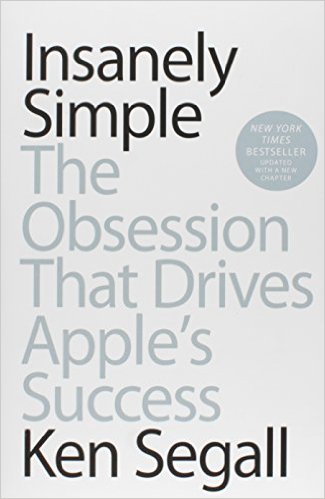
(Yep, I’m referencing Apple again in this space… but hey, they’ve got a track record at doing this right, have they not? Just looking to learn from the top.)
Says Segall, the best meetings… as in, the kind that generated great ideas that got “done” after
the meetings ended… had two simple rules.
First, they were small.
In a book excerpt that showed up on fastcodesign.com, Segall tells the story of a meeting where Steve Jobs walks in to a meeting room and starts talking… only to stop and jab a finger at one of the attendees.
“Who are you?” he said.
The attendee, named Lorrie, starts explaining that she’s working on the marketing for some of the products that might come up. Jobs says to her, “Thanks, but I don’t think we need you here.” So Lorrie has to get up and leave.
Whether you’re meeting with a new client or an ongoing one, try to do the same if you can. That is, think small.
I have some precise ideas on how small. For instance, I think three is ideal. At most, five. If you’ve got an especially passionate and knowledgeable client, you might even get away with a one-on-one meeting to start.
Don’t ask me why, but I believe an odd number of attendees are better than evens, to keep the conversation going. It just seems to be a better dynamic.
Of those, the most important person to invite is what I call a “product champion.” That is, the person who believes most in the value of whatever you’re trying to sell. He or she might even be the person that created it or works on perfecting it, on a daily basis.
Next, you also want to have some kind of “rubber- meets-the-road” person. This is the one who will make sure the ideas happen, after the meeting ends. Preferably, this is someone with a financial stake in the outcome too.
After that, if you want more people, they’d better be talkers, question-askers, and idea- challengers. The guy who just sits there is rarely an asset, unless he’s the kind that will kick in at the end with a brilliant insight.
But you can’t make that guy or anybody else “be brilliant.” Nor can you order him to participate. You can only make sure you invite the right people (and only those people) in the first place.
Here’s how Segall puts it:
“When you push for small groups of smart people, everybody wins. The company gets better thinking. The group feels better appreciated and is eager to take on more work. This type of organization actually fuels productivity, project to project.”
The second “rule,” says Segall, is to aim to keep the agenda simple but NOT formal and organized.
Far better, he says, is an informal agenda.
That flies in the face of what every cubicle- loving drone or cutthroat, no nonsense CEO seems to embrace.
Time, they’ll tell you, is money. And nobody has time to sit around just talking. But here’s the thing: There can be magic in the randomness.
Yes, go in knowing what you hope to cover, but don’t be brutal about squelching any other tangents.
The key to making the chaos productive isn’t a strict agenda, it’s in being more rigorous about that first step instead. That is, make sure the chatter produces by rigidly inviting only the right, passionately interested participants.
That said, if a meeting is clearly going nowhere, don’t be afraid to cut it short. If everybody at the table is asleep, you’re better off coming back to the problem at a different time.
Likewise, don’t be fooled by “efficient” meetings that measure success by how many ideas they produce. Developing one or two good ideas with enough footing to get off the ground is far better than cranking out piles of mediocre ideas that will never go farther than the conference table.
Yes, it requires stamina for some to stay on one topic for a full meeting. Many aren’t up to it. But in the long run of a working relationship, you’ll actually solve more problems AND see the solutions realized more often if you tackle one challenge at a time and tackle it well.
One last thought: when used wrong, meetings end up being the place where people do more talking about the “real work” that needs doing than actually doing anything. But used right, meetings don’t have to be a drag on your career. Rather, they can be the tool that energizes your creative process, rather than throttling or taming it.
If you’re sitting down in small groups where no participants can hide behind a notebook or free doughnut… where you can feed off the passion they bring… and you can get up from the table with one or two ideas you can’t wait to test in the real world, then you’ll know you’ve done it right.
One more “last” last thought: Many use meetings to find creative consensus. That’s also a mistake. Ideas formed by committee are rarely worthwhile.
You’re better getting up with a disagreement that will drive a defensive brainstorm than you are getting up with some watered down concept that nobody quite loves.